 X
X
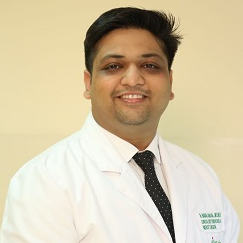
DR NAVAL BANSAL
General Surgeon
- Fees: INR 500
-
Monday 9:00 AM - 5:00 PM
(See all timing)Monday 9:00 AM - 5:00 PM,
Tuesday 9:00 AM - 5:00 PM,
Wednesday 9:00 AM - 5:00 PM,
Thursday 9:00 AM - 5:00 PM,
Friday 9:00 AM - 5:00 PM,
Saturday 9:00 AM - 5:00 PM
Introduction
Dr. Naval Bansal is one of the best General Surgeon in Mohali, Punjab with an experience of 4 years in this field. Dr. Naval Bansal is currently attached to Fortis Hospital at Mohali. Dr. Naval Bansal is a board certified expert in Endocrine and Breast Surgery. He did his MBBS and MS (General Surgery) from Christian Medical College & Hospital, Ludhiana. Dr Naval Bansal then received a structured training in Endocrine Surgery at Sanjay Gandhi Post-graduate Institute, Lucknow. Dr. Bansal has a vast experience in Thyroid, Breast, Parathyroid, Adrenal, Pancreatic and Diabetic surgeries etc. He also has an enriching experience in minimal access & robotic Endocrine surgery from Republic of Korea and can perform these surgeries with excellent cosmetic results. He pioneered the concept of Endoscopic scarless thyroid surgery in this region. Dr Bansal's other keen areas of interest include surgeries for breast cancer like conservative breast surgery, sentinel lymph node biopsy, oncoplastic breast reconstruction. Dr Naval Bansal is one of the best General Surgeons of Mohali with 4 years on experience in this field.
Hospital Associations
Fortis Hospital, Mohali.
Services/Interest
- Endocrine Surgery
- Breast Surgery
- Sentinel Lymph node Biopsy
Professional Memberships
IAES (Indian Association of Endocrine Surgeons), ASI (Association of Surgeons of India), ABSI (Association of Breast Surgeon of India).
Awards and Recognitions
First prize in quiz at SGPGI breast course and ABSI workshop-2014, ICMR short term student scholarship 2005, State scholarship for outstanding performance in 8th, 10th and 12th Board examination.
Education
MS (General Surgery), Christian Medical College & Hospital, Ludhiana, M.Ch (Endocrine Surgery),Sanjay Gandhi Post-graduate Institute, Lucknow.
I Speak
English, Hindi.
Feedback For Dr Naval Bansal
Write FeedbackFortis Hospital Mohali Timing
Monday - Friday
9:00 AM - 5:00 PM
Saturday
9:00 AM - 5:00 PM
Who is a general surgeon?
General surgery is a medical discipline that entails performing various types of surgical procedures to treat a broad range of health problems and diseases. A general surgeon is a practitioner of general surgery and has been trained in the diagnosis and preoperative, operative, and postoperative management of patient care and requires to have the knowledge of emergency & intensive care, anatomy, metabolism, immunology, nutrition, pathology, physiology, shock, and wound healing. In general surgery, the surgeon is required to perform both pre- and post-operative care and management other than the surgery itself as well as diagnosing several types of diseases, especially those that are related to the abdomen and the organs connected to it, including bile ducts, liver, spleen, pancreas, appendix, small and large intestine, rectum, and the stomach. The general surgeon may also operate the thoracic region, glands in the thyroids, and hernias, and to a certain extent, are also responsible for procedures performed on the skin and the breast.
Why would you be referred to a general surgeon?
Doctors work closely with general surgeons if the treatment plan requires a more invasive intervention, which could be because the medications didn't work or won't work on you unless a blockage or something like that has been removed by the general surgeon. You may be sent to a general surgeon because the surgical procedures needed are within the scope of the general surgeons, which include resections of the abdomen or the colon, organ transplantation, etc. Patients who need to undergo weight loss surgery are also sent to general surgeons since weight loss surgeries such as lap band often deal with the abdomen and its contents. The patients require emergency care are also sent to general surgeons as some injuries can be so severe the patients would require surgery as soon as possible, like resuscitating the patient in shock that is possible due to the broad knowledge and skills of general surgeons. These emergencies can also include skin burns, amputated limb or finger, internal bleeding, and blockage in the airways. The general surgeon is expected to have knowledge in surgical treatment, the evaluation & diagnosis such as interpreting existing medical records and radiologic results, and administration of drugs such as antibiotics and other fluids. Moreover, the surgeon has to show skills in wound healing, management of pain especially after the operation, infection control, and nutrition.
How is the general surgeon different than other surgeons?
General surgeons are the physicians trained to treat a wide variety of conditions that may require surgical interventions. In many cases, surgeons perform routine types of surgeries, such as removal of the appendectomies and gallbladder. But there are other instances, where general surgeons perform more complex surgeries involving the digestive, endocrine, and vascular systems. But surgeons who wish to specialize may take different routes, and there are several surgical specialties for doctors who are interested in narrowing their focus. For example, pediatric surgeons are trained to perform surgery on children and cardiovascular surgeons operate on the heart and blood vessels of the cardiac system. Some additional types of surgical specializations include trauma where surgery is performed on patients who have acute injuries as the result of traumas, such as a road accident or gunshot. Surgical specialties also exist in areas including reconstructive surgery, transplants, neurosurgery, and orthopedics.
What are the surgeries performed by a general surgeon?
Some of the most common surgical operations performed include the following:
- Appendectomy: It means the surgical removal of the appendix, a small tube that branches off the large intestine, to treat acute appendicitis which is the acute inflammation of this tube due to infection.
- Breast biopsy: It is a diagnostic test involving the removal of tissue or cells from breasts for examination under a microscope.
- Carotid endarterectomy: It is a surgical procedure that is done to remove blockage from carotid arteries which are the arteries located in the neck and supply blood to the brain.
- Cataract surgery: Cataract surgery is performed to remove the cloudy contents with ultrasound waves.
- C-section: It is the surgical delivery of a baby by an incision through the mother's abdomen and uterus.
- Cholecystectomy: It is the surgery done to remove the gallbladder, a pear-shaped sac near the right lobe of the liver that holds bile.
- Other surgeries performed by the general surgeons are Coronary artery bypass, Debridement, Dilation, Free skin graft, Hemorrhoidectomy, Hysterectomy, Hysteroscopy, Inguinal hernia, Low back pain surgery, Mastectomy, Partial, Total (or simple) mastectomy, Modified radical mastectomy surgery, Radical mastectomy, Partial Colectomy, Prostatectomy, and Tonsillectomy.